Sunday, March 29, 2009

Bavaria

Bavaria


On my recent short trip to Munich/Bavaria I took advantage of any time off to look again at the landscape I grew up with, but this time with my 'new' (botanically educated) eyes. This country of rolling hills and lakes, formed by the retrieving glaciers, is rich in history and cultivation of its fertile soils. 

'Our milk makes Bavaria strong!'

And yes - this is dairy country at it's best! One thing that I learned to truly appreciate only when i moved away is the Northern European law of the 'freedom to roam'.This also might explain why the people here go so often for 'walks' one could call this is a national pastime. 
But then there is also the pilgrimage, a extended version of the walk, usually directed towards a church housing some ancient reliquaries. These churches are often part of large monasteries, which commonly house breweries and inns. One of my favorite is 'Kloster Andechs', famous for it's dark beer and beer garden. One way to get there is a 21/2 hour walk through some of the most beautiful of Bavaria's landscapes.

Hedera helix

Hedera helix fruit

One thing I noticed more this time, probably because of the leaf less season, is the amount of ivy growing up trees. Ivy is a native here (in contrast to the US where it is considered an invasive) and has a strong tradition of symbolic and medicinal use, going all the way back to the Egyptians. It is strongly associated with the roman god of wine, Bacchus, and the Greeks wore ivy wraths around their heads believing it to wake 'bacchanal enthusiasm' and to cool their brains while drinking and eating until they passed out.... 
As to the ivy completely covering the trunks of so many trees, there is no evidence found to today that this is detrimental to the tree, as long as it does not shade out the host.

Corylus avellana, female flower

Corylus avellana, male catkin and female flower

Another plant that is visually dominant this time of the year is the common hazel, Corylus avellana, another native around here. The yellow catkins covering these shrubs early in the spring before the leaves come out, make this plant highly visible along the forest and field edges and also in parks and gardens. This is a very important food plant going all the way back to the Mesolithic age, when it was the dominating woody plant in the forests of central Europe.
Clematis vitalba

Also highly visible are the fluffy seed heads of Clematis vitalba, a native climber that covers deciduous trees and shrubs along the edges of woods, and is a nitrogen indicator. And in the right light it is absolutely gorgeous!

Eranthis hyemalis

I just learned Eranthis hyemalis to be native to southern Europe, but this little beauty has been cultivated here since the 16th century and is wildly naturalized. As it is one of the first flowers in the season it is important as first food to bees. All parts of these little tubers are highly poisonous, making the plant popular with murderers of the Greek mythology.

reflection in shallow pond

old infructescent of Carduus acanthoides

The walk to Andechs leads you through these wonderful light forests dominated by the European beech tree Fagus salvaticus. This is my favorite tree of them all, and I have to apologize for the lousy picture (please do not click on this one - it's embarrassing)

Another plant that has a lot of meaning to me is Hepatica nobilis, the common liverwort native to Europe. This beautiful little gem of the Ranunculaceae family typically grows in these beech forests, and has recently been renamed to Anemone hepatica, but I am not sure how accepted this new classification is.
As a little child I often went into the woods behind my parents house to collect small bouquets of this flower, gifting it to whoever I found worthy of it that particular day.
 
leaf of Hepatica nobilis


Hepatica nobilis flower

The name is easy to remember if you look at the leaf shape and color. The purple color of leaf, stem and flower is associated with the pigment Anthocyan, which is said to be able to convert light into heat, and such preventing the delicate little thing to die off in the frosts still occurring around this time of the year.

Salix caprea, male catkins before release of pollen

And then there is  the 'Palmkatzerl' Salix caprea. The hairy little male flowers are very popular cuttings for vases, especially around Easter and Palm Sunday, alas the name, loosely translated as 'palm kittens'.


Part of the walk is along cultivated fields, still not tilled after last years harvest, and sometimes way to close to those fields that have freshly been fertilized with cow manure. But that's part of country life....


The rewards of the long walk (if it is not enough in itself) wait inside the large dining hall of the cloister. A shared mass (one liter) of the famous dark beer draft, now during lent with even more alcohol content, is almost a meal in itself and the hardy plate of pork roast with the finest crust (I suspect some more dark beer involved there) with a real pretzel (not to be confused with those preetzel-like things sold in Central Park), and a healthy portion of sauerkraut - this should illustrate what pilgrimage means to me.


The monastery sits absolutely picturesque on top of a large hill overlooking the 
lake Ammersee, and on our way down we caught the last of the late winter sun sinking into the lake behind the trees.


I felt we did properly pacify the winter gods, and honored the beginning of spring.


Wednesday, February 11, 2009

How I Met Darwin

How I Met Darwin 


My biggest and most enduring passions in life are traveling and the natural world. I have been to the Galapagos Islands several times, the first was 23 years ago, when I saw Darwin’s famous islands arriving on a freight ship from Guayaquil. I had been on my first long voyage, traveling the Andes, when inspired by a photograph of the sky over the archipelago I headed out to sea. This first travel truly changed my life. It awakened lifelong passions that, growing over all those years,  I now make my profession. And it inspired me to learn more about Darwin, which is not so surprising as I had dreamed of being an explorer since childhood.


My most recent visit found the place as fascinating as ever, and I learned a lot of new things about every aspect of nature – including my own species (Homo sapiens). There was a lot of new development in the town of Puerto Ayora, and many places were hard to recognize. Some people I had met during previous stays were now gone, and others, trying to eradicate invasive species, had carried their passion for this marvel of nature to new levels of dedication.


In the highlands I saw (and heard...) the giant tortoises mate, and got really nostalgic seeing my hammock trees, the gigantic and non native balsas. I took several day trips on boats, and learned to appreciate the ocean surrounding the islands even more than before. These waters are teeming with the most amazing life, from crustaceans to the most colorful fish. Over 300 species have already been described from the rich ocean waters around the archipelago, and there is a strong effort made to giving them the same protection and control as life on land.

Chamaesyce amplexicaulis 
Euphorbiaceae- Native, from Isla Bartolomé

On the morning of the last day of my stay I decided to visit Tortuga Bay as a final good by. The hike from town takes a little less then an hour, starting at a tall rock overhang, which used to be a large obstacle along the trek, and now is the edge of the rapidly expanding residential development. A new cobbled path leads you over fields of rough lava, with the occasional group of tree opuntia.


In this arid coastal zone giant prickly pear (Opuntia echios variation gigantean and O. echios variation barringtonensis) and candelabra cacti (Jasminocereus thouarsii) grow on what seems to be barren lava flows, but actually hosts the most species. The path is great for bird watching; endemic mockingbirds and the famous finches flew by on their search of food in the first hours of the equatorial day.


Lizards basking in the emerging sun spread out on the black lava. This was a quiet place this early, permitting intimacy with my beloved Galapagos sky, dominating this island world.
  

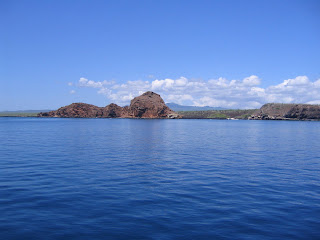
Finally, I arrived at the long, wide beach. Years before I had seen sea (the pacific green) turtles laying their eggs here, but this was neither the right season nor the right time of the day. It was going to be a sunny and hot day, and the Pacific honored it’s name by producing a mellow surf. 


In the shallow water I could spot the fins of small sand sharks breaking the surface, and the few rocks on this sand beach hosted the ever-present sea iguana drying in the sun and spitting sea salt.


Luminous orange-red Sally-Lightfoot crabs contrasted with the black lava, and sanderlings ran up and down the water line.  


I had a wonderful walk along this absolutely pristine beach, and went all the way to it's end. Another well-laid path allowed me to walk along the water further, eventually leading me to a place where more birds were fishing along this rocky mangrove (Rhizophora mangle
) coastline, and I sat down for a while to watch them hunt for breakfast. 
What pure pleasure to take them all in on my last day of visiting. I think I remember masked boobies, a brown pelican,  lava gulls chased by the perpetual robbers the frigatebirds, and red-billed tropicbirds among others. I watched them for nearly an hour, and when I turned around I stared at a booby, sitting only a few meters to my right watching a lava heron, which in turn was watching the water’s surface intently for little fish. Sweet!


A turtle swam by, into the lagoon, and at one point I thought I could see a small manta fly by underwater. What a perfect good-by those Galápageños were giving me! 

But the sun was standing higher now, really heating up the day. I decided to finish the last part of the path and go swimming in the small sheltered bay, hidden around a long bend. The path led me to an area with an old grove of gorgeous tree opuntias, and immediately there were a few finches circling about.

Coming around another turn I startled; 

A few meters ahead between a few tall plants, stood a man wearing a old straw hat and wide shirt and trousers of a rough material which looked like linen. I looked closer:

He was a young odd-looking fellow with huge 19th century reddish-blond sideburns, staring at me at least as surprised as I was.


‘Hi – my name is Darwin’, he said with a clearly British voice.


‘Hi – I thought so!’ I answered without thinking.


What a stupid response, where were my manners? How about a polite “Nice to meet you Charles, heard a lot about you!”

Something was truly odd here, and in my puzzlement I turned to my left still not thinking properly.

There it was: about half a dozen more people, all in normal modern clothing, holding microphones and cameras. A film crew!

And not just any film crew as it turned out, but those insanely dedicated and talented guys that were finishing the shooting of the great BBC documentary ‘Galapagos: The Islands That Changed the World’.

We exchanged a few greetings and explanations, and they asked if I had seen any sand sharks. After I told them where, I went on my way, still quite bedazzled.


Yes – my Darwin was ‘only’ a filmmaker taking advantage of his likeliness with the great naturalist, and was acting as him in a segment of the documentary – but to me, that morning, I had truly met Charles Darwin in his world.

Happy Birthday

Saturday, January 31, 2009

Winter in the Conservatory


Winter in the Conservatory
The American Desert House and especially the African Desert House at the Enid A. Haupt Conservatory are some of my favorite places, especially this time of the year. 
While a lot of plants are dormant in the new world, the old world is in bloom. Euphorbiaceae, Crassulaceae, Senecio spp., and most spectacular the Aloe spp., are showing their best colors now. It is strange to see these plants flower in January here in NY, exactly 6 month after staying in South Africa during peak Aloe-bloom-time. This is 'natural' behaviour nevertheless, as they obviously react to the temperatures and amount of light they are getting now. I am still not completely clear on how these two factors, combined with the amount of moisture available, really determine the plant cycles. I am also learning more and more about how much, or little, control there is in an artificial indoor environment.  
One thing this very clearly demonstrates is, that these African desert tropicals are from the south of the southern half of the globe. I love how horticulture and botany tie in with geography!

    Cotyledon tomentosa, Crassulaceae

 flower

I did not even notice when I took the following two pictures, but they are a wonderful example illustrating convergent evolution! 
All Agave spp. are from the Americas, and all Aloe spp. originate in the African Continent. They belong to different families, and are not closely related. Equally arid conditions, and similar ecosystems resulted into almost identical physical appearance. Evolution is definitely one of the larger 'transmission gears' in the complex interactions of the natural world.

Aloe sp. Asphodelaceae, detail

Agave sp. Agavaceae, detail

Agave sp., unfolded leaf detail


The genus Crassula might have some of my favorite flowers, here you see a very typical example. Note how half the anthers'  pollensacs already releasing their pollen (white tips), and how the stigmas are still arranged in this neat onion shape (they will unfold and become receptive later to avoid self-pollination).
        
 Anther and Stamen diagramm

Crassula ovata, Crassulaceae


Tuesday, January 20, 2009

President


Monday, December 8, 2008

Tennessee


Tennessee

I spend the week of Thanksgiving in and around Knoxville, Tennessee and Ashville, North Carolina, as guest of Sarah and her parents. What beautiful country this is! And I do not say this just because I am American citizen now and have a sudden rush of patriotism. Rolling green (there is pine and still some hemlock) ridges, if seen from up high changing into fading shades of steel blue. Really pretty!

This is LULU

We went hiking and geeking out on plants, shopped at famous Hammer’s in Clinton (I got me a flannel plaid John Deere jacket-!), had a memorable dinner at ‘Tables’, explored the brand new arboretum and kept eating well thanks to Liz.

I did very much enjoy the flora being so different to up north - but here the trees rule! To me extensive deciduous forests like these are still exotic.


Our rental in front of Starbucks...

We gave considerable business to various Starbucks’ in the two states, some being actual drive-throughs. In NY I am not such a fan, but out here driving, they are fabulous I have to admit.

Great shopping out here!

The only thing missing was DOLLYWOOD. I am a great fan, and we drove right by it - but I was told it was the wrong time of year, so I am looking forward to to a similar trip in the spring! 

The Smoky Mountains